Welcome to the Historical Society of Orange Park
Let's make our community a better place!
Vision Statement
The Historical Society of Orange Park exists to educate the community about the rich and dynamic history of the greater Orange Park, Florida area including the contributions of those individuals, civilian and military, that shaped our past and enriched the present.
Mission Statement
To accomplish our objective, the Society collects, preserves and displays historical artifacts and relics of the past. We research and document topics of local interest then share these stories with the community. We collect, preserve and display printed and digital materials of historical value. We arrange or facilitate educational and historical tours, field trips, exhibitions and displays for residents of the greater Orange Park, Florida area.
We are always looking for volunteers to help us make our vision a reality. The Society has opportunities for research, community service and leadership, offering the chance to learn and share local history in a variety of ways. Opportunities include digitizing historical documents, helping with podcast creation, live-history re-enactment
We are always looking for volunteers to help us make our vision a reality. The Society has opportunities for research, community service and leadership, offering the chance to learn and share local history in a variety of ways. Opportunities include digitizing historical documents, helping with podcast creation, live-history re-enactment and more. We offer people of all ages a chance to help others tell the story. By joining the Society, even if for just one project, you will be fascinated by what there is to learn.
Whether you help through monetary donations, volunteering your time, or spreading our mission through word-of-mouth, thank you! We couldn't accomplish our goals without the help of supporters like you.
Please click the links below to obtain a copy of our current newsletter or a recent newsletter.

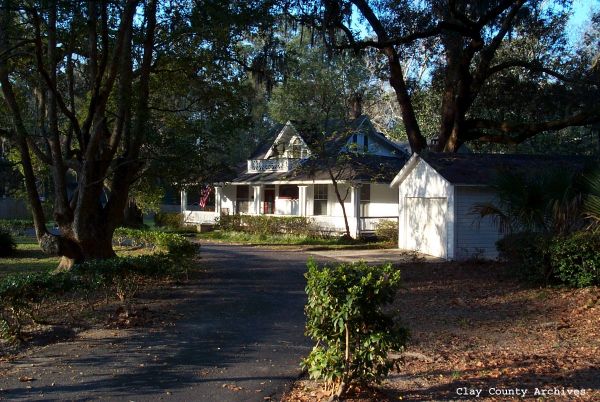
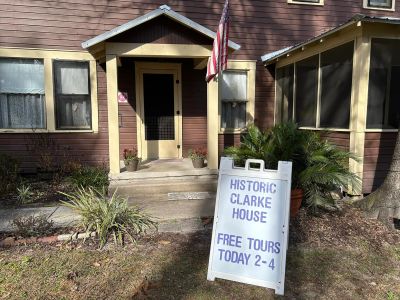
The Clarke House, built in 1912 and located in Clarke House Park, 1039 Kingsley Avenue, is open for tours the second Sunday of each month from 2 PM to 4 PM. Sunday afternoons are the perfect time for a leisurely tour of the house, both upstairs and downstairs.

Join the Historical Society of Orange Park as we sew together decades of
local history to link nuns and needy kids to this estate on River Road.
Tuesday, April 14th, 6 PM at the Orange Park Branch Library, 2054 Plainfield Avenue, Orange Park, Florida 32073
What started as a simple question developed into a very satisfying and significant part of Orange Park history!

The history of 1400 Plainfield Avenue began in the early 1880s, when Washington Gano Benedict sold nine acres to Edward and Amanda Clark of Flint, Michigan in 1881. A year later, they sold the north half of that tract to Erastus and Anna Dodge, also of Flint. These early owners were part of the wave of Northern investors who bought Orange
The history of 1400 Plainfield Avenue began in the early 1880s, when Washington Gano Benedict sold nine acres to Edward and Amanda Clark of Flint, Michigan in 1881. A year later, they sold the north half of that tract to Erastus and Anna Dodge, also of Flint. These early owners were part of the wave of Northern investors who bought Orange Park land in the 1880s development boom but never settled on it. The Clarks died of typhoid pneumonia in 1884 and for decades, the parcel remained raw, unimproved land.
The first actual residents were immigrants from Eastern Europe. Frederick Joseph “Fred” Zwirner fled Austria during the First World War as a pacifist who chose not to fight. Coming from a prominent Viennese family, he was smuggled out with the help of friends, first into Germany, then England, and finally onto a ship bound for New York. There he met Pauline Pausz, a spirited young woman from the Schwabenland region of Germany, who would later be his wife.
Pauline could not read or write when she arrived here and spoke little English. Fred taught her to sign her name. They moved to Orange Park to build a farm. They sold milk for 12 cents a quart and eggs for 12 cents a dozen. Paulines herb garden was expansive and considered her “pharmacy” for teas and potions. Fred’s mother, Barbara Zwirner, lived with them, much to Pauline’s chagrin. Barbara remained with them until her death in 1926.
The home they lived in was built between 1915 and 1922. The Zwirners were the first long‑term occupants and likely builders of the original home. Once the farm was established, Fred became an inventor of mechanical devices. Beginning in 1929, Jacksonville newspapers recorded his inventions aimed at improving leaf springs, load distribution, and vibration control in early automobiles and trucks. His inventions, including the Oscillating Spacer, Loadbalancer, Waveline‑Spring, Triangle‑Spring Combination, and Springpower Equalizer, demonstrate his knowledge of mechanical challenges of his time.
The home reflects the practical, owner‑built construction typical of the late 1910s, when families cleared their own land, milled local lumber, and built homes suited to the climate and the rhythms of daily life. It’s a one‑and‑a‑half‑story wood‑frame house with a simple rectangular footprint and a gabled roofline. The exterior is wrapped
The home reflects the practical, owner‑built construction typical of the late 1910s, when families cleared their own land, milled local lumber, and built homes suited to the climate and the rhythms of daily life. It’s a one‑and‑a‑half‑story wood‑frame house with a simple rectangular footprint and a gabled roofline. The exterior is wrapped in horizontal wood siding. The roof was likely cedar or metal when first built, with generous eaves to offer shade and protect from heavy rain. The two front dormers weren’t decorative, but functional. They brought light into the attic, allowed heat to escape, and made the space usable for storage or overflow sleeping.
The back service area likely had open shelving for jars and tools, a wash basin, hooks for drying herbs and a screened section to keep insects out.
The front porch was an outdoor living room, a place to cool off in the evenings, greet neighbors, and shell peas or mend tools in the shade. Its posts are simple and functional, reflecting the Zwirners’ frugal, practical approach to building. The ceilings were high not for curb appeal, but to allow heat to rise during Florida summers.
Life on the property reflected the couple’s European roots and their adaptation to Florida’s landscape. Over time, later owners made additions and updates, but the house, its frame, its proportions, its porch, and its relationship to the land reflect an early homestead. It is not a Victorian house from 1895, as modern real‑estate listings sometimes claim, but a true Plainfield Avenue farmhouse: practical, modest, and shaped by the hands and lives of the immigrant family who settled there.
In 1982, two years after Pauline’s death, the property was sold. The Martyniaks are likely the next owners, but the Gregson family lived there from the 1990s to 2015, when the Clays bought it. Finally, in 2019 ownership went to the Johnny Van Zant Revocable Living Trust, owners of other properties in the area as well.
The building is listed in the 1994 Historic Building Survey as one of the places in Orange Park that should be preserved for its significance to the history of Orange Park. It stands right across the street from Orange Park Elementary School, thus anchoring the past with the future.

In recent months, the Board has been working out the details of a $1000 scholarship to be offered to eligible seniors at Orange Park High School. The group felt it important to give back to the community and to help a deserving senior as they prepare for college. Prospective applicants must be preparing to enter either a four- or two-year college or career/technical school. Other criteria are: 3.0 GPA, must be representing the school in a respectful manner, be a member of at least one community service organization, and write an essay on the topic – How has history and community service shaped you as a person and prepared you for the future? A grateful thank you goes out to Dairy Queen and Boger’s Shoes for their contributions which helped fund the scholarship. Once the scholarship is awarded, we will publish the winner’s information in the newsletter.
Please consider assisting in funding next year’s scholarship or connecting us with a business that may be willing to be a sponsor.

Homeschool, civic and social groups are welcome to schedule a free guided tour of the 1913 historic Clarke House and/or Magnolia Cemetery. For more information, contact the Historical Society of Orange Park at info@ophistory.org. Groups will be scheduled based on the availability of guides.

Road Trip! Join us for a Saturday adventure back in time to old Florida!
The Bartram Frolic & Festival honors the natural beauty, culture, and heritage that Bartram captured in his writings — encouraging visitors to reflect, explore, and engage with the St. Johns River in meaningful and recreational ways.
• Live Music & Performances
• Nature-Based Exhibitors
• “Passport to the Past” Adventures
• Living History Reenactors
• Local Vendors, Makers & Artisans
• Bartram Society Exhibits &
Interpretive Experiences
Come stroll, listen, learn, and connect with the landscapes that shaped our history and still inspire us today.
Members can drive separately or join up to carpool. Meet up at 9:00 AM a location to be determined soon. Those in the carpool will return by 4:30 PM. If you are interested, please contact us at info@ophistory.org.
The Society is looking for photographs to add to our resources. If you have long-time-ago images of people and/or places in Orange Park, please share them. In this increasingly visual world, there is a lot to learn from these glimpses of our past. You can share them through email at info@ophistory.org or through mail at P. O. Box 08, Orange Park, 32067. Originals will be returned after the Society makes a scan.


Looking for somewhere to explore or something to do in Clay County? Visit the Explore Clay website, Explore Clay County - Small Towns, Big Passions, for plenty of suggestions.
One of the activities is a tour of historic buildings in Orange Park. This driving tour takes you to 23 historical structures that hold positions of prominence in Orange Park’s history and continue to serve today. Please remember most locations are private residences and should be viewed from the street.
To access the tour visit, download the Explore Clay mobile app from the Explore Clay website or by clicking: Clay County - Mobile App. Once you have the app downloaded, search for the tour then dive into the rich history of Orange Park.
WXJT Neighborhood Videos- On February 4th, Channel 4 initiated a series of local focus programming. Orange Park was the first neighborhood to be featured. The Society assisted with this over the course of around three months. The videos that resulted are available online at: https://www.news4jax.com/topic/ORANGE_PARK/
The following videos were made with the Historical Society:
Lawrence Hicks- https://www.news4jax.com/news/local/2025/02/03/orange-park-historical-society-honors-legacy-of-ice-man-lawrence-hicks/
Orange Park Normal School: https://www.news4jax.com/community/2025/02/04/historic-orange-park-normal-and-industrial-school-taught-black-white-children-under-one-roof-in-late-1800s/
Clarke Family: https://www.news4jax.com/news/local/2025/02/04/inside-clarke-house-a-glimpse-into-a-1912-treasure-in-orange-park/

428 Park Avenue and 372 Blanding Blvd., Orange Park, FL 32073

1494 Park Avenue
Orange Park, FL 32073

111 Blanding Blvd.
Orange Park, FL 32073

1988 Wells Road
Orange Park, FL 32073

Historical Society of Orange Park
P.O. Box 08, Orange Park, Florida 32067
We use cookies to analyze website traffic and optimize your website experience. By accepting our use of cookies, your data will be aggregated with all other user data.